Showing posts with label hvac appliances. Show all posts

Tuesday, December 18, 2012

Automatic Controls for Electric Furnaces

The automatic controls used in an electric heating system are designed to ensure its safe and efficient operation. This section is primarily concerened with outlining the operating principles of the automatic controls used with an electric furnace. These controls include room thermostat, thermostat heat anticipator and timing sequences. In a central heating system, the wall-mounted room thermostat is the control that governs the normal operation of the furnace. The operating principle is simple. The temperature selector on the thermostat is set for the desired temperature. When the temperature in the room falls below this setting, the thermostat will call for heat and cause the first heating circuit in the furnace to be turned on. There is generally a delay of about 15 seconds before the furnace blower starts. This prevents the blower from circulating cool air in the winter. After about 30 seconds, the second heating circuit is turned on. The other circuits are turned on one by one in timed sequence.

Use a heat pump thermostat or a conventional thermostat containing an electric setting to operate an electric furnace.
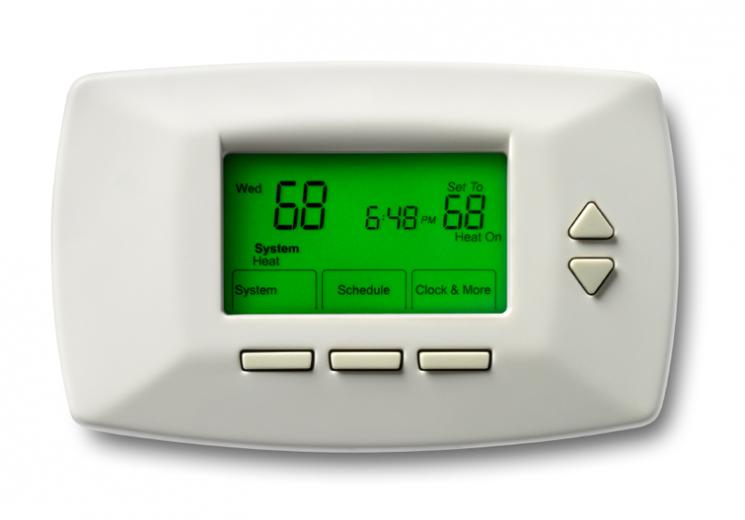
When the temperature reaches the required level, the thermostat opens. After a short time, the first heating circuit is shut off. The others are shut off one by one in timed sequence. The blower will continue to operate until the air temperature in the furnace drops below a specified temperature.

A typical room thermostat will have a fan switch, a system switch and a temperature selector. The temperature selector on the thermostat is used to select the desired temperature. The actual operation of the heating system is governed by the position of the fan and system switches.

Most room thermostats contain a heat anticipator. This is a device designed to assist the thermostat in controlling closer to the to the desired temperature range.

When timing sequence are used the current flowing through the first time-delay sequencer must also flow trough the heat anticipator. In order to obtain satisfactory operation, the heat ainticipator setting must be equal to the current draw of the sequencer.

The furnace manufacturer will generally recommend the setting for the heat aniticipator adjustment for each size unit. For example, this setting recommended for a Trane Model EUADH 07 electric furnace is .45. This thermostat adjustment will vary depending upon the type of time-delay sequencer used, the furnace manufacturer, and the size of the furnace. This may be illustrated by the recommended heat-anticipator setting given by Coleman for its furnace models. All Coleman 25-kW, and 20-kW furnace models require a heat ainticipator setting of .60.

After you have adjusted the heat anticipator to the suggested setting, operate the furnace several hours and observe the results. If there is insufficient heat, it may be caused by short furnace cycles. This can be corrected by moving the heat-anticipator pointer to a slightly higher setting. If there is too much heat, the long furnace cycles are overheating the structure. This can be corrected by moving the heating-anticipator pointer to a slightly lower setting. After making these thermostat adjustments, allow the furnace to operate several hours to determine whether further adjustment is required.

Friday, November 30, 2012

Take care of your HVAC equipment through regular servicing

Written by Victor
Having invested in a home, you would want to make sure that you are able to live comfortably in it through different weather conditions. This is where various HVAC equipment or heating, ventilation and air conditioning equipment as they are better known, come in handy.
But just buying them is not the end of the story. You need to maintain your outdoor heaters, patio heaters and evaporative cooling systems well enough so that they always perform at optimum levels. While some of the basic maintenance can be done by yourself, you need to hook up with a specialist HVAC maintenance agency for regular inspection and any required corrective action. These agencies have the necessary personnel, testing equipment and professional attitude to do a good job so that you do not have to spend money later on to get certain parts and so on.

The maintenance that can be done by you includes using a vacuum cleaner to get rid of the accumulated dirt, along with any dust around the blower wheel and flue. Any build up of dust can hamper the smooth working of the motor and will drive up your energy costs. Changing of the filter is another task you should be able to manage and though this just takes a minute or two, most of us tend to ignore the monitoring and maintenance of this vital part. It is the filter that traps any excess dirt and prevents it from getting into the ducts of the equipment. Clogging of the filter will result in HVAC appliances such as a patio heater or outdoor heater to work much harder in order to be able to ensure circulation of air into the system. The result is that you will end up paying more in energy charges and the unit will also break. Hence either clean the filter regularly or change it if required to ensure smooth working of the unit. 

About the Author:
Celmec - international is one of the leading manufacturers of HVAC equipment. Visit their site http://www.celmec-international.com/ to know more about them.